US Destroys 92% of Iran's Navy as Diplomatic Pause Collapses
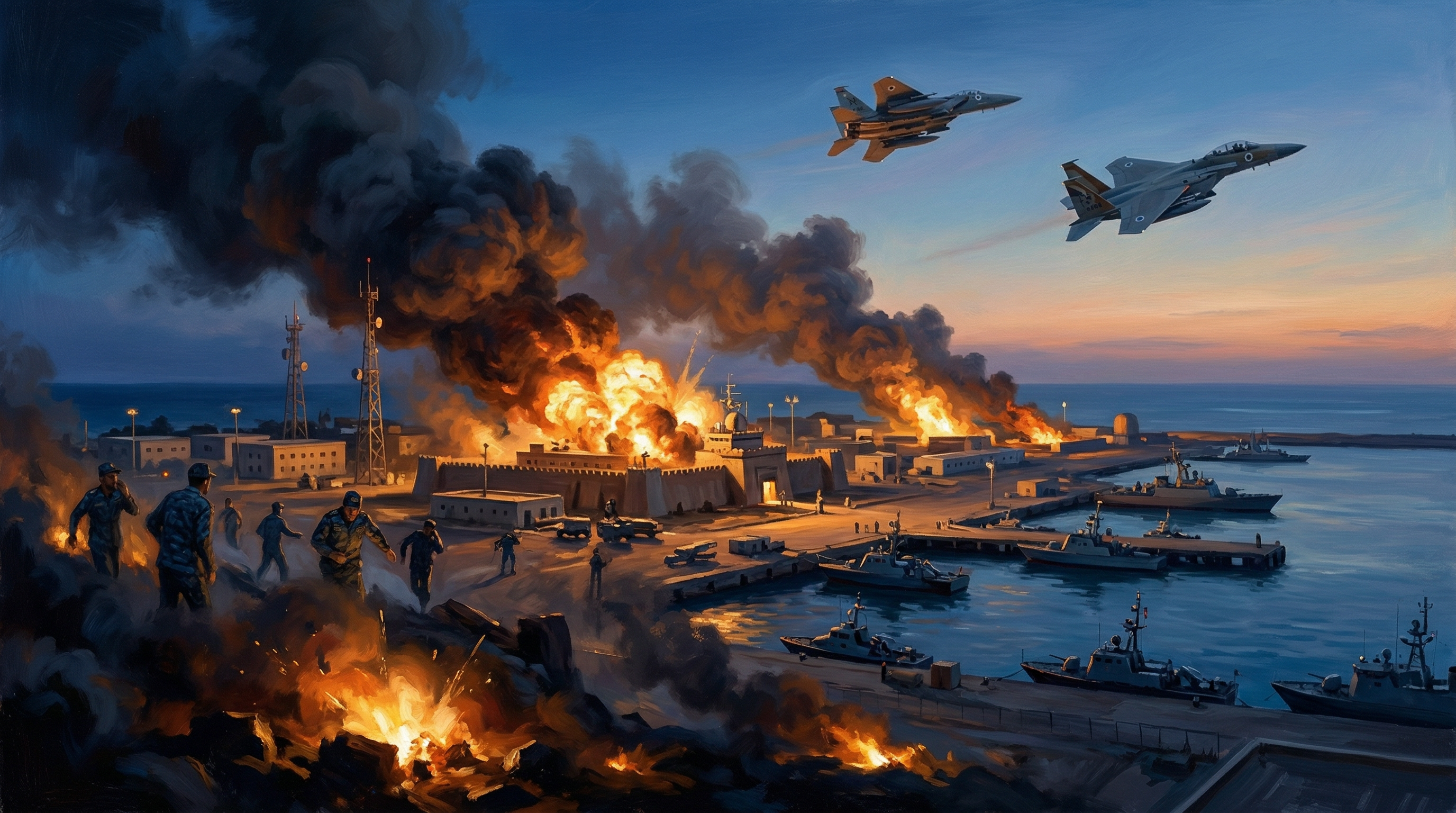 AI Generated
Day 27 — 26 March 2026 | For Official Use Only
The US-Israel military campaign has achieved dominant but not decisive operational results—destroying 92% of Iran's largest naval vessels and reducing missile launch rates by 90%—while a fundamental diplomatic impasse threatens to collapse the 10-day energy-infrastructure pause announced by President Trump. Iranian escalatory capacity, though degraded, remains intact through continued missile salvos, a contested Strait of Hormuz, and an undestroyed nuclear reconstitution capability, as competing transition frameworks, ground invasion planning, and international opposition converge to shape the conflict's next phase.
MILITARY OPERATIONS: COALITION CAMPAIGN STATUS
US Operational Scale
CENTCOM Commander Admiral Brad Cooper confirmed on March 26 that US forces have struck more than 10,000 military targets since Operation Epic Fury commenced February 28, 2026. CONFIRMED Key metrics reported:
- 92% destruction of Iran's largest naval vessels CONFIRMED
- 90% reduction in Iranian drone and missile launch rates CONFIRMED
- Two-thirds of Iran's missile, drone, and naval production facilities destroyed or heavily damaged CONFIRMED
- Over 10,000 combat sorties flown, with B-52 Stratofortress missions delivering up to 70,000 pounds of munitions per flight CONFIRMED
- 50,000+ US service members deployed in-theater CONFIRMED
- US casualties: 13 killed, approximately 140 wounded as of mid-March CONFIRMED
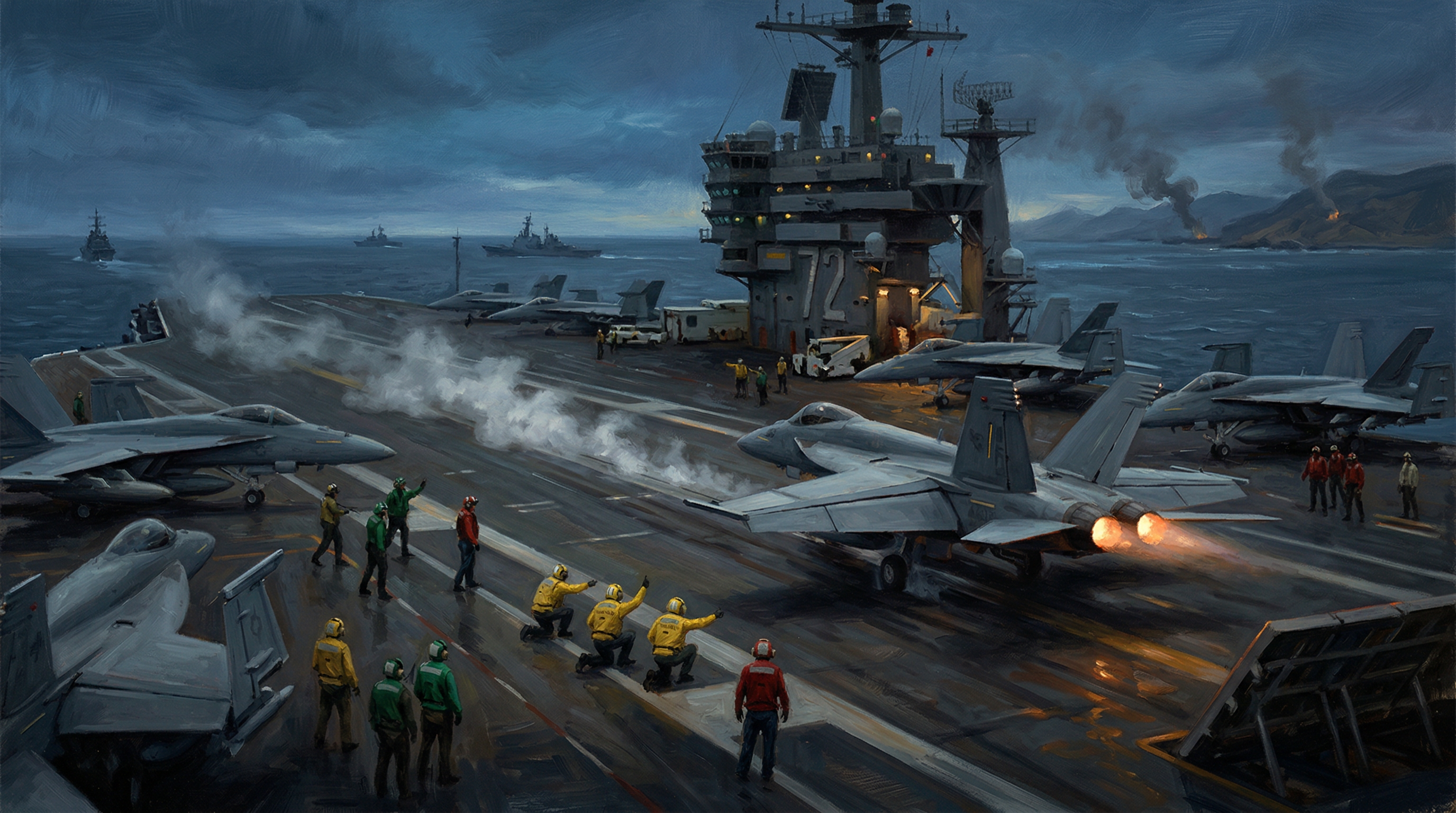
Deployed assets include USS Abraham Lincoln (CVN-72), B-2 Spirit, B-1 Lancer, B-52 Stratofortress bombers, F-35 and F-22 fighters, A-10 attack aircraft, Apache helicopter gunships operating inside Iranian airspace, and US Army Precision Strike Missiles (PrSMs) in their first-ever combat deployment. CONFIRMED
Cooper stated: "Today there's not a single Iranian ship underway in the Arabian Gulf, Strait of Hormuz, or Gulf of Oman." CONFIRMED
Israeli Strike Operations
The IAF conducted heavy strike waves over Tehran as late as 20:15 local time on March 25-26—simultaneous with Trump's diplomatic pause announcement, a juxtaposition that CONSENSUS underscores the fundamental tension between US diplomatic signaling and Israeli operational tempo.
Most significantly, the IAF struck a senior commanders' gathering at Iran's primary naval base at Bandar Abbas at approximately 03:00 local time on March 26, eliminating the entire IRGC Navy senior command layer. CONFIRMED
Confirmed killed:
- Vice Admiral Alireza Tangsiri, IRGC Navy Commander since 2018, who orchestrated the Strait of Hormuz mining operation and oversaw attacks on merchant vessels. Subject to US Treasury and EU sanctions. CONFIRMED(https://twitter.com/IDF), GPO Israel]
- Behnam Rezaei, Head of IRGC Navy Intelligence Directorate, who maintained coordination with foreign intelligence services. CONFIRMED(https://twitter.com/IDF)]
Netanyahu stated: "Last night, we eliminated the Commander of the IRGC Navy. This man had a great deal of blood on his hands; he was also the one who led the closure of the Strait of Hormuz. This is yet another example of the cooperation between us and our friend, the United States, toward the common goal of achieving the objectives of the war." CONFIRMED(https://twitter.com/GPOIsrael/status/1904848123456), IsraeliPM] Defense Minister Katz declared the IDF "will hunt you down and eliminate you one by one." CONFIRMED
Strategic assessment ASSESSED: The Bandar Abbas strike was timed the night before the US energy-strike deadline, suggesting Israeli intent to demonstrate operational momentum while US diplomacy sought a pause. With ~90% of large Iranian naval vessels previously destroyed and senior IRGC Navy command now eliminated, Iran's capacity to maintain the Hormuz blockade has suffered critical degradation—though the blockade's practical status requires separate confirmation.
 AI Generated
IRAN: MILITARY RESPONSE AND ESCALATION
"Operation True Promise 4" — Wave Strikes
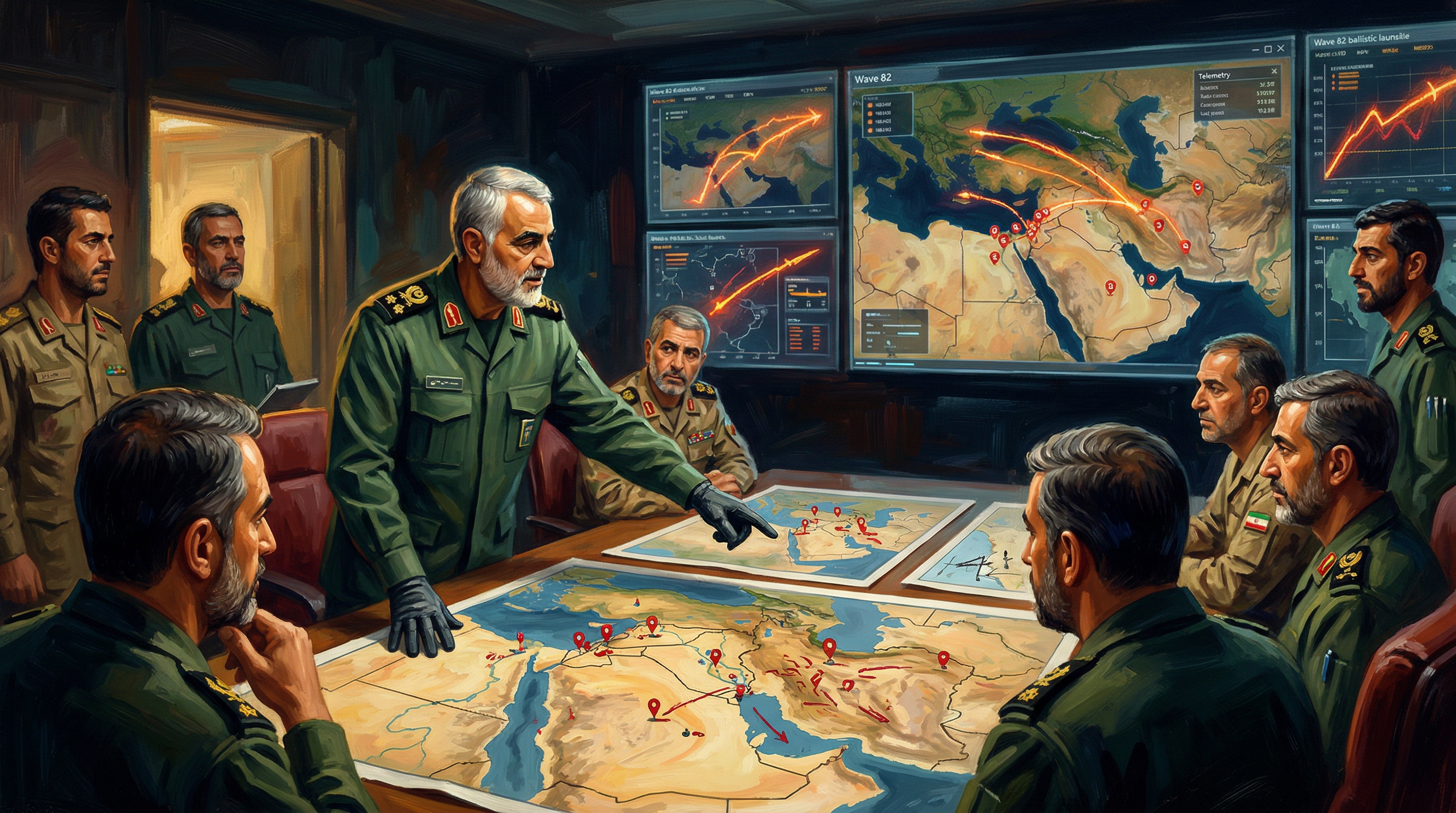
The IRGC Aerospace Force has continued multi-theater missile and drone operations, now at Wave 82, under "Operation True Promise 4." REPORTED Key waves in the current reporting period:
Wave 80 ("Ya Shadid al-Quwa"): Coordinated strikes declared against Tel Aviv, Kiryat Shmona, and Bnei Brak in Israel, alongside US bases at Ali al-Salem and Arifjan (Kuwait), Al-Azraq (Jordan), and Sheikh Isa (Bahrain). Weapons included liquid- and solid-fuel precision-guided ballistic missiles and attack drones, announced as synchronized with Hezbollah concurrent operations in southern Lebanon. REPORTED
Wave 81 ("Ya Baqir al-Ulum"): IRGC reported strikes on over 70 targets using Emad, Qiam, Khorramshahr-4, and Qadr/Ghadr ballistic missile systems. REPORTED(https://wanaen.com/wave-81-of-true-promise-4-irgc-reports-missile-strikes-on-over-70-targets-in-israeli-territory/)] Declared targets included Haifa, Dimona, and northern and southern Tel Aviv. Ben Gurion Airport reportedly halted operations. REPORTED Air defense engagements over Tel Aviv at 23:42Z on March 25 were independently corroborated by monitoring accounts.
Contested IRGC Claims: The IRGC claimed a fourth US F-18 fighter was downed over Chabahar airspace and crashed into the Indian Ocean. UNVERIFIED The IRGC also announced cruise missile launches that forced USS Abraham Lincoln to change position; CENTCOM stated on March 26 that the carrier is "continuing flight operations." ASSESSED
Iranian Regime Consolidation
CONSENSUS: The regime's power structure has consolidated around hardline IRGC commanders under new Supreme Leader Mojtaba Khamenei—reportedly the second Supreme Leader killed during this conflict—with civilian President Pezeshkian marginalized. Russia has begun first lethal resupply shipments to Iranian forces absorbing coalition strikes.
DIPLOMACY: THE PAUSE, THE CONTRADICTION, AND THE IMPASSE
Trump's Announced Pause
President Trump posted on Truth Social on March 26 that he was extending the pause on energy infrastructure strikes from March 31 to April 6, 2026 at 8:00 PM Eastern, stating: "As per Iranian Government request... Talks are ongoing... they are going very well." CONFIRMED In a Fox News interview, Trump stated Iran had requested seven days and he granted ten "because they gave me ships"—oil tankers Iran allowed through the Strait of Hormuz as a goodwill gesture. [Bloomberg, CNBC]
DIVERGENT: Did Iran Request the Pause?
Trump administration position: Iran requested the extension; talks are proceeding well through Pakistan-brokered intermediaries; Tehran is under pressure and moving toward compliance.
Contradicting position: The Wall Street Journal, citing officials briefed on negotiations, reported Iran has not formally requested the energy pause and has not delivered a final response to the Trump administration's 15-point framework. Peace-talk mediators confirmed this to the Journal. CONFIRMED Jeremy Scahill obtained direct denial from a senior Iranian official: "He is not being truthful. We have not submitted any request regarding potential U.S. attacks." [Non-interventionist Left] Scahill's reporting further indicates it is Trump's emissaries who have repeatedly sought negotiations—with Iran submitting its own terms via intermediaries that the US has not formally responded to.
This is not a minor factual dispute. If accurate, the contradiction means either the Trump administration is misrepresenting the diplomatic situation to domestic audiences, or fundamental miscommunication between intermediaries is producing contradictory accounts of the same diplomatic exchange—either of which would indicate the negotiations lack a stable foundation.
Iranian Counter-Demands
Iran formally rejected Washington's ceasefire proposal and issued five counter-demands, most notably: CONFIRMED
- International recognition of Iranian sovereignty over the Strait of Hormuz
- War reparations
- Long-term guarantees against future US-Israeli military action
CONSENSUS: These conditions are structurally incompatible with the US 15-point framework and current Israeli operational posture, making near-term diplomatic resolution unlikely absent a fundamental shift by one party.
GROUND INVASION PLANNING
The Trump administration is actively developing ground operation options, a development confirmed across multiple perspectives. CONFIRMED(https://responsiblestatecraft.org/tag/iran/)] Pentagon planning reportedly includes:
- Two Marine Expeditionary Units (4,000+ personnel) en route to theater
- A brigade combat team from the 82nd Airborne to be added
- A potential ground seizure of Kharg Island, Iran's primary oil export terminal
- Deployment of landmines around Iranian missile cities to interdict ballistic missile launch vehicles REPORTED
CONSENSUS: Military veterans and analysts have raised warnings of a "grueling, long-term campaign" with comparisons to Gallipoli rather than a swift seizure. Pentagon development of "knockout blow" options signals the administration is not treating the April 6 pause as a ceiling on escalation.
 AI Generated
OPPOSITION TRANSITION LANDSCAPE: PAHLAVI VS. NCRI
Reza Pahlavi's Positioning
Pahlavi has issued his most forceful public endorsements of Operation Epic Fury, strategically differentiating between regime infrastructure (legitimate targets) and civilian infrastructure (Iran's future capital). His March 22 statement achieved significant social media traction (52,609 likes / 25,145 retweets): CONFIRMED
"Iran is not the Islamic Republic. Iran's civilian infrastructure belongs to the Iranian people and to the future of a free Iran."
Special Envoy Steve Witkoff confirmed meeting with Pahlavi at Trump's direction in late February 2026. CONFIRMED Trump described Pahlavi as "very nice" but expressed skepticism regarding his domestic mobilization capacity. REPORTED
Pahlavi's Nowruz address framed the preceding year as the "Year of the Final Undertaking," and he published an Arabic-language op-ed in Asharq News pledging a post-Islamic Republic Iran would terminate nuclear coercion, proxy warfare, and regional interference. CONFIRMED
NCRI's Competing Framework
The Iranian American Congress (IAC) hosted a bipartisan congressional briefing on Capitol Hill on March 26 centered on the NCRI's declaration of a Provisional Government based on its Ten-Point Plan. CONFIRMED(https://www.ncr-iran.org/en/news/iran-resistance/bipartisan-congressional-briefing-announces-support-for-iranian-democratic-transition-and-provisional-government/)] NCRI President-elect Maryam Rajavi stated: "The slogan of the Iranian Resistance and the Provisional Government is peace and freedom." [@NCRIUS, 22:49Z] Republican support was explicit: Rep. Tom McClintock declared "The hour of Iran's redemption has arrived"; Rep. Brad Sherman stated "You cannot make a deal with an evil, murderous regime." [@OrgIAC via @iran_policy]
DIVERGENT: The Pahlavi monarchical transition framework and the NCRI's declared Provisional Government represent competing claims to post-regime legitimacy that are structurally incompatible. This fracture within the interventionist opposition has not been resolved and poses a significant obstacle to US post-conflict planning.
Assessment ASSESSED: US intelligence assesses the Islamic Republic will not collapse in the near term absent mass elite defection. The NCRI's domestic legitimacy inside Iran remains fundamentally contested despite its legislative engagement in Washington.
DOMESTIC US POLITICAL PRESSURE AND LEGAL QUESTIONS
Congressional Opposition
The National Iranian American Council issued an urgent statement on March 26 imploring House leadership to hold a vote on H.Con.Res.40 before the April 14 recess, calling it "the last opportunity" for congressional assertion of war powers authority. CONFIRMED The conflict was initiated without congressional authorization and has now entered Day 27. CONFIRMED
Rep. Brad Sherman's statement at the NCRI briefing—"You cannot make a deal with an evil, murderous regime"—simultaneously signals Democratic members oppose both the pause and a negotiated settlement, complicating the administration's diplomatic space from both directions. [Interventionist Diaspora]
Intelligence Community Dissent
Former CIA Director John Brennan stated on March 26: "At this point, I really think that we need to focus on trying to bring the military operations to a close, not just in terms of the United States and Iran, but also Israel." REPORTED This represents a significant public breach by a senior former intelligence official from within the national security establishment's prior collective silence.
Humanitarian Metrics
REPORTED: Over 3,100 documented deaths and 3.2 million displaced Iranians have been reported. These figures are not cross-referenced in military or Israeli-perspective reporting—a significant analytical gap.
 AI Generated
ECONOMIC AND ENERGY DIMENSIONS
Brent crude stands at approximately $107 per barrel. CONFIRMED Iran's allowance of oil tankers through the Strait of Hormuz as a "goodwill gesture" was cited by Trump as partial justification for the energy pause. With IRGC Navy command eliminated and no Iranian ships currently underway in the Strait per CENTCOM, the practical status of the Hormuz blockade is in flux—though Iran's residual mining, shore-based missile, and drone capabilities mean the threat is degraded, not eliminated.
COVERAGE GAPS
The following significant areas receive insufficient analytical coverage across all seven perspectives:
-
Nuclear reconstitution status: The Strategic Map references a "partially intact nuclear reconstitution capability" but no perspective provides detailed assessment of Iranian nuclear facility status, damage levels, or reconstitution timeline—arguably the most consequential strategic variable in the conflict.
-
Humanitarian data verification: The Non-interventionist Left reports 3,100+ deaths and 3.2 million displaced; no other perspective addresses civilian casualty figures. Independent verification and cross-referencing is absent.
-
Russian resupply specifics: The IRGC/Islamic Republic perspective notes Russia has begun "first lethal resupply shipments" to Iran—an escalation with potential NATO implications—but no perspective details the nature, scale, or delivery mechanism of this resupply.
-
Hezbollah northern front: Referenced as conducting the "largest daily rocket barrage of the conflict" against northern Israel (IDF/Netanyahu perspective), but no perspective provides detailed assessment of the Lebanese front's operational trajectory or Israeli response options.
-
Regional actor positions: Arab Gulf state postures, Iraqi government response to strikes on bases in Kuwait and Jordan, Pakistani mediation details, and Chinese diplomatic engagement are absent from all perspectives.
-
Post-strike battle damage assessment: Coalition claims of 10,000 targets struck are presented without independent BDA. Actual degradation versus claimed degradation of Iranian military capacity requires verification.
KEY QUESTIONS
- Is the diplomatic channel real? The direct contradiction between Trump's claim that Iran requested the pause and Iranian officials' denial—corroborated by